Devils on the Moon Pinball
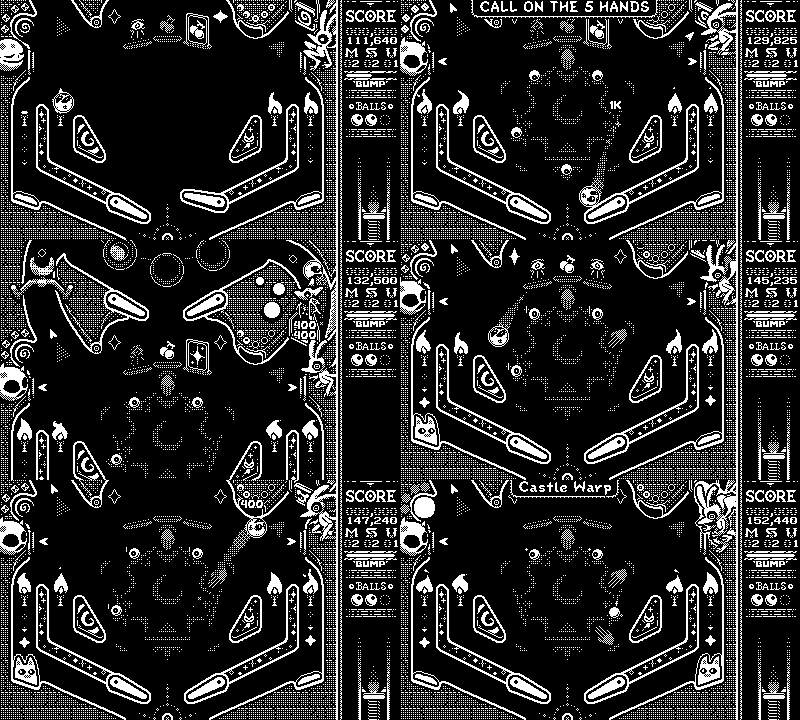
I love pinball. We did a whole show about it if you listened to our Indie and Retro Podcast back in the day. I’ve been to many conventions and shows. I was nationally ranked on the IFPA (low, but still). There probably isn’t a pinball hall in Colorado I haven’t seen, and that goes for most in the Bay Area, as well. Sometimes I still fire up Pinball Arcade on the ol’ Xbox when I don’t have the time or will to play something more involved. Pinball is plenty involved, but in a different way than something narrative. It just takes your complete concentration as you slip into a flow state. I have so many tables on that thing, and we finally have the technology to get the physics right.
Still, after all that, my first video game pinball love was Kirby’s Pinball Land on the original monochrome Game Boy. It was not a fast game. The physics were what you can expect from a Game Boy game. The graphics smeared when Kirby went too fast. Some of the ball drains felt a little unfair. But there was so much to discover. It had boss battles, and hidden secrets all over, and multiple tables. It was the perfect game to keep in your Game Boy for any occasion and any length of backseat car trip, up there with Tetris. Devils on the Moon Pinball for the Playdate feels like the next generation of Kirby’s Pinball Land, and I can’t come up with a higher compliment than that.
For the longest time, we didn’t have the power to fully simulate pinball physics in games, so a lot of the way the ball flew off the paddles was based off pre-defined scripts (according to a pinball game developer I talked to at E3 once – please forgive me if this is not true at all). That’s why, if your timing was perfect in old pinball games, you’d be able to make the same shot over and over and over again. That’s not how it feels or works in a real-life pinball machine, where even two identical machines can play completely differently just due to minor imperfections in the wood, a slight bump on a paddle, or a different batch of rubber used to manufacture the bumpers.
The Playdate is not a powerful system; it’s much more Game Boy than PS5. Which means that the pinball physics are probably not “true” physics, and it’s just a lot of clever programming. But DotM doesn’t feel like those old pinball games, with pre-defined ball routes. Maybe they are, but you’d never be able to tell. It’s fast. The ball “feels” correct even when it’s a little game-y, like when it kind of magnets itself up the upper loop, and unlike the Pinball FX games, which can veer too far into the fantastical both with their concepts and physics.
In Devils on the Moon Pinball, you’re trying to capture 50+ devils, one at a time. There’s only one main table, but each of the three connected screens has its own set of goals, and there are “boss” tables and tons of things to learn. That’s one of my favorite parts of any new pinball table: learning the rules. I’d recommend you read the impeccably designed instruction manual before hopping in here! Understanding what targets you should actually aim for and what you’re trying to do has always made a pinball machine click better for me. Tales of the Arabian Nights? Collect seven jewels and defeat the genie. Medieval Madness? Destroy the castles. Devils on the Moon? Capture the devils. And yes, the occult setting and general vibe of this game is a lot more like Devil’s Crush than Kirby’s Pinball Land, but I never tried that one! Definitely going to go back and check it out now, though.
There are overall and daily leaderboards to try and top, even though the scores on there already seem unbeatable. And yet, one good game and you’ll believe you can get up there, too. That’s the thing about pinball. Sometimes, with a combination of luck, skill, and an understanding of the game’s mechanics, you can have a perfect game. But another thing about pinball: it always ends. Luckily, this one isn’t trying to steal quarter after quarter from you, so it’s actually pretty forgiving? The Ball Save stays lit for a lot longer than it would in a real pinball machine, just in case it drains too quickly right out of the gate. And the table bumping ability – while not unlimited; there is a tilt if you push it too far – lets you nudge your ball around the field more than even in Sonic Spinball. There’s even a crank mechanic that helps you on one section of the board, but moving your hand from the buttons to the crank is a whole other challenge.
After you unlock the bonus boards, whether by capturing devils (something usually only accomplished on the high-risk/high-reward lowest third of the table) or beating the boss battles, they appear in your bestiary with a small lore blurb. And if you saw a hidden board but didn’t manage to capture the boss devil, you can try again from the main menu, along with earning a letter grade for beating it quickly. Getting the highest score has always been a main goal of pinball, but me, personally, I really like to see the story that these games tell with nothing more than a little ball slamming into things in the correct order.
Devils on the Moon Pinball was one of the most anticipated Playdate games of all time, and I haven’t seen one person that hasn’t been satisfied with their purchase after the years-long wait. We did get to play CatchaDiablos as part of Season Two from the same developers while this one was still in the oven, and you can really feel the occult themes they share (I love when a dev has a VIBE). But now that we have this… man. It’s going to be hard for another pinball game – maybe even another GAME game – to compete on the Playdate. The only real issue? What if I get too good, and then my few minutes of pinball turns into an hour? Three balls can last a long time, if you’re good! (I’m not.) (Yet.)
(Released March 26, 2026, on Catalog. Copy provided by developer.)