Isolates
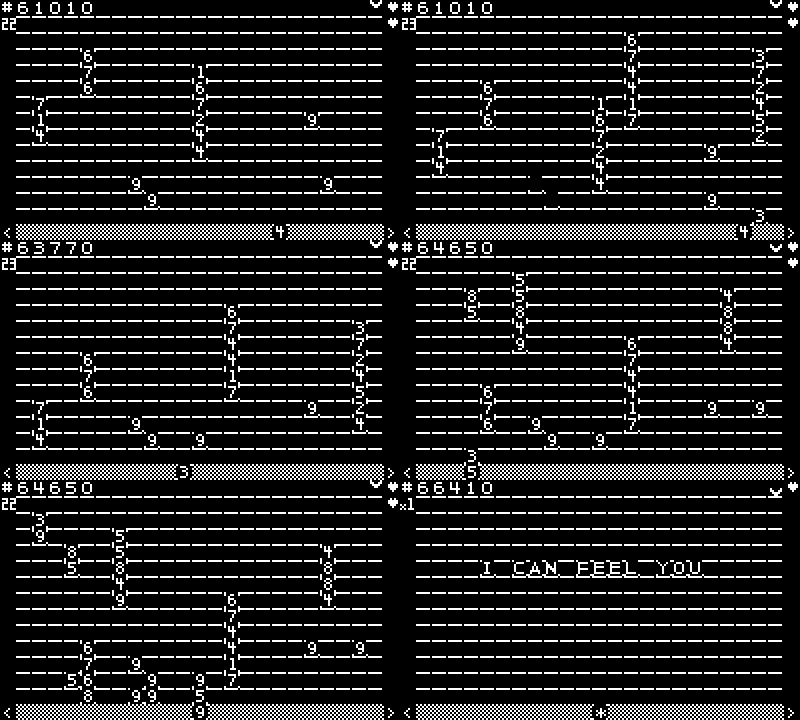
Do you remember the movie Mercury Rising, with the little kid that decodes some secret government code because he’s really good at pattern recognition? Or maybe The Number 23, the movie where Jim Carrey gets really obsessed with the number 23 and starts seeing it everywhere? I’ve heard that this is the hottest Jim Carrey has ever looked in a movie, but I’m not really sure how to quantify that. Anyway, not the point. The point is that if you get really good at Ledbetter’s latest game Isolates, you too can start seeing patterns all over the place, and everything comes back to the number 9.
Described as “slow math arcade horror” (partly as a joke because so many people are scared of math), this is nonetheless a game that’ll make you think very fast, even while things on the screen move very slow. Strings of numbers fall from the sky, and your job is to blast them with either their digital root or its complement. Which is… just such a wacky galaxy brain concept for a game that I had no clue what to expect in my first play, even after reading all the tutorial screens.
The game itself plays a bit like Centipede, where you move back and forth across the bottom of the screen and shoot a chosen single digit integer upwards at slowly descending enemies. The unique style of the game really sets it apart, though: it’s like you're playing on one of those split-flap display boards at an old airport. I could also see this game working well when projected onto the side of a skyscraper. And it was all done in Pulp.
Okay, let’s see if I can explain how this actually works… The “digital root” of a number is always one digit, and it is found by adding all the digits in the number up, as many times as necessary. So the number 45916 is 4+5+9+1+6=25, and then you split that 25 into 2+5=7, so the “digital root” is 7. And the complement of that number, for reasons explained elsewhere, is the number that, when added to the digital root, equals 9. So in this case, 7+x=9, so x=2. In Isolates, If you see the number 45916 falling from the top of the screen, you can shoot it with the digital root of 7 for a small amount of points, or hit it with the complement of 2 for much more points and a multiplier increase if you hit it with a second 9. Repeat this process with every falling number to score as high as you can, as the numbers get longer and more frequent in either Arcade or Endless mode (Endless mode in particular really amps up the “horror” part of “slow math arcade horror” in ways I don’t want to spoil).
The key to doing well at this game isn’t just by adding quickly: it’s by pattern recognition, ignoring useless noise, and understanding the power of the number 9. For example, in 45916, you don’t have to add them all up. You instead will learn to automatically filter out unnecessary information, which is a useful skill in real life as much as it is here. There’s a 9 in there, so just ignore that, leaving 4516. Then, 4 and 5 add up to 9, so you can ignore those, too, leaving just 16 left. Much easier to add 1+6 than 4+5+9+1+6, especially while there are other parts of the screen demanding your attention at the same time. You’ll still get to the digital root of 7. There is a series of numbers that this works with, described on Ledbetter’s devlog, and if you play this game too much, you will start noticing these patterns in real life. Is that a good thing? Dunno! But digging through the noise and filtering out stuff that won’t improve your life is a great skill to have, especially in this always-connected world we find ourselves in.
This game is a bit like being shown a new color. Fractals and kaleidoscopes and geometric patterns and all sorts of mathematical equations are floating all around us in the world, in nature, on license plates of the cars driving by. Pay attention and you might start seeing things in a whole new way. Not a lot of games even attempt this, and they shouldn’t! But this one… I’m glad it does.
(Released October 13, 2026, on Catalog and Itch. Copy provided by developer.)